
Security is an essential requirement in both residential and commercial environments. As storage spaces become increasingly compact and specialized, the demand for reliable, space-saving locking mechanisms continues to grow. Among the most versatile and widely used security devices is the miniature cam lock. Despite its small size, this locking solution provides dependable protection for cabinets, lockers, drawers, mailboxes, vending machines, electrical enclosures, and numerous other applications.
Miniature cam locks have become a cornerstone of modern access control systems due to their simplicity, durability, affordability, and ease of installation. Manufacturers continuously innovate to improve lock security, corrosion resistance, and customization options, making these compact locks suitable for an expanding range of industries.
This article explores the structure, working principles, materials, types, applications, advantages, installation methods, maintenance requirements, and future trends of miniature cam locks.
A miniature cam lock is a compact locking device designed to secure doors, panels, drawers, and compartments. The lock consists of a cylindrical body installed through a mounting hole and a rotating metal arm, known as a cam, attached to the rear of the lock.
When a key is inserted and rotated, the cam moves into either a locked or unlocked position. This simple rotational movement provides an effective means of securing access points while maintaining a compact design suitable for limited spaces.
Miniature cam locks are commonly found in:
- Office furniture
- Filing cabinets
- Mailboxes
- Lockers
- Display cases
- Cash boxes
- Electrical cabinets
- Medical equipment
- Industrial control panels
- Vending machines
- Retail point-of-sale equipment
Their compact size and straightforward operation make them one of the most practical locking solutions available today.
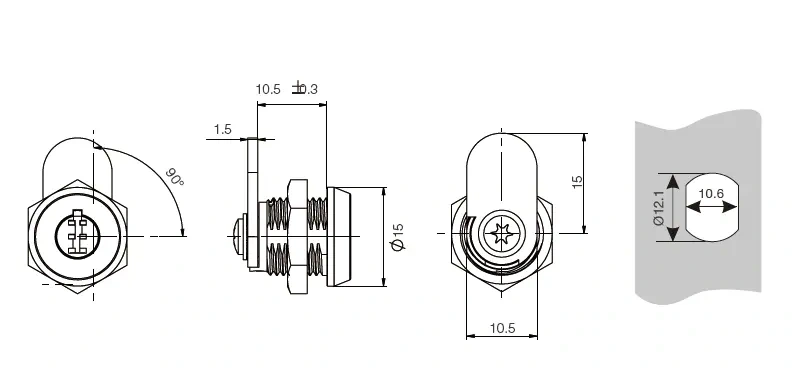
The operating mechanism of a miniature cam lock is relatively simple but highly effective.
The lock body contains a cylinder equipped with a series of pins or tumblers. When the correct key is inserted, the pins align properly, allowing the cylinder to rotate.
As the cylinder turns, the attached cam rotates simultaneously. Depending on its position, the cam either engages behind a fixed surface to secure the compartment or moves away to allow opening.
The process typically involves:
- Inserting the key.
- Aligning internal pins or tumblers.
- Rotating the cylinder.
- Turning the cam.
- Locking or unlocking the door.
This straightforward mechanism minimizes moving parts, reducing wear and enhancing reliability over long service periods.
Although miniature cam locks vary in design, most models consist of several essential components.
The cylinder houses the internal locking mechanism and serves as the key entry point. It is usually manufactured from zinc alloy, brass, or stainless steel.
The cam is the rotating metal arm attached to the rear of the cylinder. Different cam shapes and lengths are available to accommodate various door thicknesses and locking requirements.
The key activates the lock by aligning internal components. Depending on the lock design, keys may be flat, tubular, or specially coded.
A retaining nut secures the lock body to the mounting surface and prevents movement during operation.
Washers help distribute mounting pressure and improve installation stability.
These components provide security by preventing unauthorized rotation of the cylinder.
Together, these components create a compact yet effective locking solution suitable for countless applications.
Manufacturers offer numerous miniature cam lock configurations to address varying security needs.
Each lock operates with a unique key.
- Advantages include:
- Enhanced security
- Individual access control
- Reduced risk of unauthorized entry
These locks are commonly used in offices, schools, and commercial facilities.
Multiple locks share the same key.
Benefits include:
- Convenience
- Reduced key management
- Faster access to multiple compartments
They are popular in retail displays, storage cabinets, and maintenance facilities.
Master-key systems allow individual locks to have unique keys while permitting authorized personnel to access all locks using a master key.
Applications include:
- Educational institutions
- Hospitals
- Commercial buildings
- Government facilities
Tubular locks feature a circular key design that provides greater resistance to picking compared to standard flat-key locks.
Common uses include:
- Vending machines
- Gaming equipment
- Coin-operated devices
- High-security cabinets
These locks eliminate the need for physical keys by utilizing a numerical combination.
Advantages include:
- No lost keys
- Simplified access management
- Reduced maintenance costs
Electronic versions incorporate digital technology, allowing access through:
- PIN codes
- RFID cards
- Bluetooth devices
- Mobile applications
These advanced locks are increasingly used in smart storage systems.
Material selection significantly influences the lock's durability, strength, and corrosion resistance.
Zinc Alloy
Zinc alloy remains one of the most commonly used materials.
Benefits include:
- Cost efficiency
- Good corrosion resistance
- Easy manufacturing
- Attractive appearance
Zinc alloy locks are ideal for indoor applications.
Brass
Brass provides excellent durability and corrosion resistance.
Advantages include:
- Long service life
- Smooth operation
- Good machining characteristics
- Attractive finish
Brass cylinders are frequently used in higher-quality cam locks.
Stainless Steel
Stainless steel offers exceptional performance in harsh environments.
Benefits include:
- Superior corrosion resistance
- High mechanical strength
- Resistance to chemicals
- Extended service life
These locks are commonly found in marine, industrial, and outdoor applications.
Aluminum
Aluminum components provide lightweight construction while maintaining reasonable durability.
Applications include portable equipment and lightweight enclosures.
Protective finishes improve appearance and environmental resistance.
Chrome Plating
Chrome-plated locks offer:
- Bright appearance
- Corrosion protection
- Improved wear resistance
Nickel Plating
Nickel finishes provide:
- Smooth operation
- Attractive aesthetics
- Enhanced durability
Black Powder Coating
Black finishes are popular in modern equipment because they:
- Reduce visibility
- Improve aesthetics
- Provide additional corrosion protection
Brushed Stainless Finish
Brushed stainless steel creates a professional appearance while resisting fingerprints and scratches.
Miniature cam locks serve a broad range of industries and applications.
Office environments frequently use cam locks on:
- Filing cabinets
- Desk drawers
- Storage cupboards
These locks protect confidential documents and personal belongings.
Retailers use miniature cam locks in:
- Display cabinets
- Point-of-sale terminals
- Cash drawers
- Product showcases
They help prevent theft while maintaining convenient access for employees.
Residential and commercial mail systems rely heavily on miniature cam locks for security.
Their compact design makes them ideal for limited installation spaces.
Industrial applications include:
- Electrical panels
- Machine enclosures
- Control cabinets
- Instrumentation boxes
These locks protect critical equipment from unauthorized access.
Hospitals and healthcare facilities utilize miniature cam locks on:
- Medicine cabinets
- Storage compartments
- Equipment carts
- Laboratory furniture
Secure storage helps protect sensitive materials and controlled substances.
Telecommunication infrastructure often incorporates miniature cam locks in:
- Network cabinets
- Outdoor enclosures
- Fiber optic distribution boxes
These locks help maintain system integrity and operational security.
The popularity of miniature cam locks stems from numerous practical advantages.
Their small size allows installation in confined spaces where larger locking systems would be impractical.
Most cam locks require only a simple mounting hole and retaining nut, minimizing installation time.
Miniature cam locks offer reliable protection at a relatively low cost compared to more complex security systems.
High-quality materials ensure long service life even under frequent use.
Numerous configurations, sizes, materials, and security levels make cam locks adaptable to virtually any application.
Their simple mechanical design reduces maintenance requirements and improves reliability.
Replacement parts and keys are readily available worldwide.
Proper installation is essential for optimal lock performance.
Door Thickness
The lock body must match the thickness of the cabinet or enclosure door.
Selecting an incorrect length can compromise security and functionality.
Cam Selection
Different cam shapes and offsets accommodate various mounting arrangements.
Choosing the proper cam ensures smooth operation and secure locking.
Mounting Hole Size
The installation hole must meet manufacturer specifications to prevent excessive movement or improper fit.
Environmental Conditions
Outdoor or corrosive environments require weather-resistant materials and protective finishes.
Security Requirements
High-security applications may require tubular, electronic, or restricted-key systems.
Routine maintenance helps maximize lock lifespan and performance.
Cleaning
Periodic cleaning removes dust, debris, and contaminants that may affect operation.
Lubrication
Specialized lock lubricants reduce wear and ensure smooth key insertion and rotation.
Inspection
Regular inspections help identify:
- Loose mounting hardware
- Worn keys
- Corrosion
- Mechanical damage
Early detection prevents unexpected failures.
Key Management
Maintaining accurate key records improves security and simplifies replacement procedures.
Although miniature cam locks provide effective protection, evolving security threats require continuous improvement.
Common challenges include:
- Lock picking
- Unauthorized key duplication
- Physical tampering
- Environmental degradation
Manufacturers address these concerns through:
- Advanced pin configurations
- Restricted key systems
- Hardened materials
- Anti-drill features
- Weather-resistant designs
- Electronic authentication technologies
These innovations significantly enhance security without sacrificing convenience.
The locking industry continues to evolve alongside advancements in digital technology.
Smart Lock Integration
Electronic cam locks increasingly support:
- Bluetooth connectivity
- Smartphone access
- Cloud-based management
- Remote monitoring
These features simplify access control and improve operational efficiency.
RFID Access Systems
RFID-enabled locks eliminate traditional keys and support rapid user authentication.
Sustainable Manufacturing
Manufacturers are adopting environmentally responsible production methods, including:
- Recyclable materials
- Energy-efficient manufacturing
- Reduced chemical usage
Enhanced Corrosion Resistance
New coatings and advanced stainless steel alloys improve performance in harsh environments.
Modular Lock Designs
Modular systems allow users to quickly replace cylinders or cams without replacing the entire lock assembly.
Selecting the appropriate lock requires evaluating several factors:
- Security level
- Environmental conditions
- Door thickness
- Material requirements
- Key management preferences
- Budget considerations
- Regulatory requirements
A careful assessment ensures the lock delivers the required balance of security, durability, and convenience.
Working with experienced lock manufacturers and suppliers can help organizations identify the most suitable solution for their specific applications.
Miniature cam locks remain one of the most practical and widely used security solutions in modern storage and access-control applications. Their compact design, ease of installation, affordability, and dependable performance make them indispensable across industries ranging from office furniture and retail displays to telecommunications infrastructure and industrial equipment.
As security requirements continue to evolve, manufacturers are introducing innovative materials, advanced locking mechanisms, smart technologies, and enhanced corrosion-resistant designs. These developments ensure that miniature cam locks remain relevant in both traditional and digital security environments.
Whether securing a mailbox, protecting sensitive equipment, or managing access to commercial storage systems, miniature cam locks provide an efficient, reliable, and cost-effective solution. With continued technological advancement and growing demand for compact security devices, the future of miniature cam locks remains strong, offering enhanced protection and convenience for businesses and consumers alike.
