
In modern residential, commercial, industrial, and recreational environments, convenience and efficiency are increasingly important alongside security. Thumb turn cam locks have become a popular solution for cabinets, lockers, enclosures, mailboxes, utility panels, and furniture because they provide quick, keyless access with simple operation and low maintenance.
Unlike traditional keyed locks, thumb turn cam locks use a manually operated knob to secure or release compartments, improving accessibility and operational efficiency. Their compact structure, durable construction, and cost-effective design make them suitable for RV storage compartments, office furniture, electrical cabinets, healthcare equipment, and industrial enclosures.
As industries continue focusing on ergonomic design and user-friendly hardware, thumb turn cam locks are gaining wider adoption worldwide. This article examines their structure, working principles, applications, materials, advantages, maintenance, and future trends in the global hardware and locking industry.
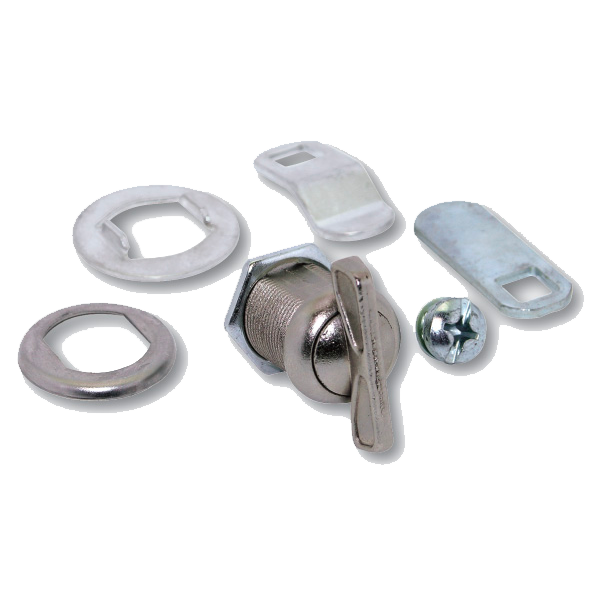
A thumb turn cam lock is a mechanical fastening device designed to secure doors, drawers, cabinets, or enclosures using a rotating cam mechanism activated manually by a thumb turn knob. Instead of using a traditional key, the user operates the lock by twisting a small lever or knob positioned on the exterior or interior side of the panel.
The lock works through rotational motion. When the thumb turn rotates, an attached cam arm swings behind the frame or strike surface, preventing the door or panel from opening. Rotating the thumb turn back to its original position releases the cam and allows access.
Thumb turn cam locks are particularly valuable in low-security applications where convenience and rapid accessibility are more important than high-level protection against intrusion. They are ideal for environments where multiple users require quick entry without carrying keys.
These locks are available in numerous configurations, including:
- Quarter-turn cam locks
- Half-turn cam locks
- Compression cam locks
- Wing knob cam locks
- Flush-mounted thumb turn locks
- Waterproof thumb turn locks
- Adjustable grip cam locks
Because of their adaptability and compact size, thumb turn cam locks are widely used in industrial equipment, transportation systems, consumer products, and architectural hardware.
The operating principle behind a thumb turn cam lock is straightforward yet highly effective. The mechanism converts rotational movement into a securing action through a cam arm mounted at the rear of the cylinder housing.
When the thumb turn is rotated:
- The spindle connected to the thumb knob rotates.
- The cam attached to the spindle swings into position.
- The cam hooks behind the cabinet frame or strike plate.
- The enclosure becomes secured.
To unlock the compartment, the user simply rotates the thumb turn in the opposite direction, retracting the cam from the frame.
The simplicity of this mechanism is one of the primary reasons for the popularity of thumb turn cam locks. With very few moving parts, the system offers excellent durability and low maintenance requirements.
Although thumb turn cam locks vary in size and design, most models include several essential components.
The thumb turn knob is the user-operated component that activates the lock. It is typically made from zinc alloy, stainless steel, aluminum, or reinforced plastic.
Designs may include:
- Wing-style knobs
- Flat knobs
- Foldable handles
- Ergonomic grips
- Textured anti-slip surfaces
The thumb turn is engineered for easy manual operation without requiring tools or keys.
The cylinder housing secures the lock body within the mounting hole of the cabinet or panel. It supports the rotating spindle and maintains structural stability during operation.
Common housing materials include:
- Zinc die cast
- Stainless steel
- Brass
- Aluminum alloy
- Engineering polymers
The cam arm is the rotating metal piece mounted on the back of the lock. It performs the actual locking action by engaging behind the frame or strike surface.
Cam arms come in multiple shapes and offsets to suit different enclosure depths and mounting configurations.
Examples include:
- Straight cams
- Offset cams
- Hook cams
- Multi-bend cams
- Adjustable cams
The mounting nut secures the lock body to the panel surface. It ensures proper alignment and prevents loosening during repeated operation.
The stop washer controls the rotational angle of the thumb turn, typically limiting movement to:
- 90 degrees
- 180 degrees
- 270 degrees
This prevents over-rotation and improves operational consistency.
The widespread use of thumb turn cam locks is largely driven by their practical advantages.
One of the greatest benefits is the elimination of keys. Users do not need to carry, store, or manage keys, reducing inconvenience and minimizing lost-key incidents.
This is especially useful in environments such as:
- Public facilities
- Shared workspaces
- Recreational vehicles
- Residential furniture
- Utility access compartments
Thumb turn locks provide immediate access with a simple twist motion. This improves efficiency in applications requiring frequent opening and closing.
Examples include:
- Tool cabinets
- Mailboxes
- Inspection panels
- Medical storage units
- Distribution lockers
Most thumb turn cam locks require only a standard mounting hole and minimal installation hardware. This makes them easy to integrate into new equipment or retrofit into existing systems.
Because the mechanism contains relatively few moving components, thumb turn cam locks generally require very little maintenance.
Unlike electronic locks, they do not require:
- Batteries
- Wiring
- Software updates
- Power sources
For low-risk applications, thumb turn cam locks provide a highly economical security solution compared with electronic access systems or heavy-duty keyed hardware.
The compact profile of thumb turn cam locks allows them to fit into confined spaces where larger locking systems are impractical.
This makes them suitable for:
- Thin metal cabinets
- Furniture drawers
- RV compartments
- Electrical enclosures
- Access panels
Thumb turn cam locks are used across a wide range of industries and environments.
In homes and apartments, thumb turn cam locks are commonly installed in:
- Bathroom privacy doors
- Bedroom doors
- Kitchen cabinets
- Mailboxes
- Storage compartments
- Wardrobes
Homeowners appreciate the convenience and simplicity of keyless operation.
Modern offices frequently utilize thumb turn locks for:
- Filing cabinets
- Desk drawers
- Employee lockers
- Storage cabinets
- IT access compartments
They help maintain organized access while allowing employees to operate storage units quickly.
RV and marine industries heavily rely on thumb turn cam locks because users often require frequent compartment access during travel.
Applications include:
- Storage hatches
- Battery compartments
- Tool storage
- Interior cabinets
- Utility panels
Corrosion-resistant stainless steel versions are especially popular in marine environments.
Industrial machinery and electrical systems use thumb turn cam locks for:
- Control panels
- Equipment enclosures
- Access doors
- Instrument cabinets
- Inspection hatches
In industrial settings, thumb turn locks improve maintenance accessibility while maintaining basic enclosure security.
Hospitals and healthcare environments use thumb turn locks in:
- Medical carts
- Storage cabinets
- Utility rooms
- Privacy doors
- Supply compartments
Quick operation is essential in time-sensitive medical environments.
Telecommunication infrastructure often includes thumb turn access systems for:
- Server cabinets
- Junction boxes
- Network panels
- Outdoor enclosures
Specialized waterproof and dustproof variants help protect sensitive electronics.
Material selection significantly affects durability, corrosion resistance, strength, and appearance.
Stainless steel is widely used for high-performance thumb turn cam locks because it provides:
- Excellent corrosion resistance
- High mechanical strength
- Long service life
- Attractive appearance
Grades such as 304 and 316 stainless steel are common in marine and outdoor environments.
Zinc die-cast locks are economical and easy to manufacture. They offer:
- Good dimensional accuracy
- Moderate strength
- Smooth surface finishes
- Cost efficiency
Zinc alloy is one of the most common materials for indoor cabinet locks.
Brass offers:
- Excellent machinability
- Corrosion resistance
- Decorative appearance
- Smooth operation
Brass thumb turn locks are often used in architectural hardware and premium furniture.
Aluminum provides lightweight performance and corrosion resistance, making it suitable for transportation and portable equipment applications.
Some lightweight applications use reinforced polymers or engineering plastics for:
- Chemical resistance
- Electrical insulation
- Weight reduction
- Cost savings
Plastic thumb turn locks are common in consumer products and light-duty enclosures.
As outdoor equipment installations continue growing, weather-resistant thumb turn cam locks are becoming increasingly important.
Outdoor locks often feature:
- Rubber gaskets
- O-ring seals
- Corrosion-resistant coatings
- IP-rated protection
- UV-resistant materials
These features help protect the lock mechanism against:
- Rain
- Dust
- Salt spray
- Humidity
- Temperature fluctuations
Weatherproof thumb turn locks are widely used in telecommunications, renewable energy systems, marine equipment, and outdoor electrical cabinets.
A specialized variation known as the compression cam lock provides enhanced sealing performance.
Unlike standard cam locks, compression locks pull the door tightly against the enclosure frame during locking. This creates:
- Vibration resistance
- Improved waterproofing
- Dust sealing
- Noise reduction
Compression thumb turn locks are commonly used in:
- Electrical cabinets
- Industrial machinery
- Transportation systems
- Outdoor enclosures
Their ability to maintain secure sealing under vibration makes them especially valuable in vehicles and heavy equipment.
While thumb turn cam locks are highly convenient, they are generally intended for low- to medium-security applications.
They are not typically designed to resist:
- Forced entry
- Advanced tampering
- High-security attacks
However, manufacturers continue improving security through features such as:
- Hidden mounting hardware
- Reinforced cams
- Anti-rotation designs
- Tamper-resistant housings
- Dual-function locking systems
For higher-security applications, thumb turn locks may be combined with:
- Key override systems
- Electronic access control
- Padlock compatibility
- Latching mechanisms
Modern hardware manufacturers are placing greater emphasis on ergonomics and user experience.
New thumb turn cam lock designs include:
- Larger gripping surfaces
- Rounded edges
- Soft-touch coatings
- Fold-away handles
- Easy-turn mechanisms
These improvements enhance accessibility for:
- Elderly users
- Individuals with limited hand strength
- Industrial workers wearing gloves
Ergonomic enhancements are becoming increasingly important in healthcare, transportation, and industrial applications.
The rise of smart infrastructure and connected devices is influencing the evolution of thumb turn cam locks.
Some modern systems now combine manual thumb turn operation with:
- Electronic monitoring
- Remote access logging
- RFID integration
- Bluetooth control
- IoT connectivity
Hybrid locking systems allow users to maintain manual emergency access while benefiting from digital monitoring capabilities.
This trend is particularly relevant in:
- Data centers
- Smart buildings
- Telecom infrastructure
- Industrial automation
Advances in manufacturing technology are improving the quality and efficiency of thumb turn cam lock production.
Modern production methods include:
- CNC machining
- Precision die casting
- Automated assembly
- Laser cutting
- Surface coating technologies
These processes improve:
- Dimensional accuracy
- Surface quality
- Corrosion resistance
- Production speed
- Cost efficiency
Manufacturers are also adopting stricter quality-control standards to ensure reliable performance across demanding operating conditions.
Surface finishing plays a major role in durability and appearance.
Common finishes include:
- Chrome plating
- Nickel plating
- Powder coating
- Black oxide coating
- Brushed stainless steel
- Electropolishing
These coatings help improve:
- Corrosion resistance
- Wear resistance
- Aesthetic appeal
- UV resistance
Decorative finishes are especially important in architectural and furniture applications.
Proper installation is essential for reliable thumb turn cam lock performance.
Important considerations include:
Panel Thickness
Locks must match the thickness of the cabinet or enclosure panel.
Cam Selection
The cam shape and offset must align correctly with the frame structure.
Rotation Direction
Some locks rotate clockwise, while others rotate counterclockwise.
Environmental Conditions
Outdoor installations require corrosion-resistant and weatherproof designs.
Clearance Space
Adequate clearance is necessary for proper cam rotation behind the panel.
Although thumb turn cam locks require minimal maintenance, periodic inspection helps ensure long-term performance.
Recommended maintenance practices include:
- Cleaning dirt and debris
- Inspecting for corrosion
- Tightening loose mounting nuts
- Lubricating moving parts
- Replacing worn cams or washers
In corrosive or high-vibration environments, more frequent inspections may be necessary.
The global hardware and enclosure market continues driving strong demand for thumb turn cam locks.
Several trends are influencing industry growth:
Expansion of Electric Vehicle Infrastructure
Charging stations and EV equipment require secure yet accessible enclosure systems, increasing demand for durable cam locks.
Growth of Data Centers
Modern data infrastructure depends on organized cabinet systems requiring convenient access hardware.
Increased Use of Modular Furniture
Office and residential furniture markets increasingly favor compact locking systems.
Rising Demand for Outdoor Equipment
Telecommunications, renewable energy, and transportation sectors require weather-resistant locking solutions.
Emphasis on User-Friendly Design
Manufacturers are focusing on accessibility, ergonomic operation, and simplified installation.
Sustainability is becoming an important factor in hardware manufacturing.
Manufacturers are adopting environmentally responsible practices such as:
- Recyclable metal materials
- Eco-friendly coatings
- Energy-efficient production
- Reduced packaging waste
- Long-life product design
Durable thumb turn cam locks contribute to sustainability by reducing replacement frequency and extending equipment life cycles.
Despite continued growth, the thumb turn cam lock industry faces several challenges.
Price Competition
Global competition creates pressure for lower manufacturing costs.
Counterfeit Products
Low-quality imitation locks can damage market reputation and compromise safety.
Corrosion Resistance Demands
Outdoor applications require increasingly advanced protective materials and coatings.
Evolving Security Expectations
Users expect improved convenience without sacrificing security.
Manufacturers must continuously innovate to balance affordability, durability, and performance.
The future of thumb turn cam locks will likely focus on several key areas:
- Smart access integration
- Enhanced ergonomic operation
- Lightweight materials
- Improved weather resistance
- Higher durability
- Sustainable manufacturing
- Modular locking systems
As industries continue modernizing infrastructure and equipment, thumb turn cam locks will remain essential components in secure and accessible enclosure design.
Thumb turn cam locks have become indispensable in modern hardware applications because they provide a practical balance between convenience, simplicity, and reliable performance. Their keyless operation, compact structure, easy installation, and low maintenance requirements make them ideal for cabinets, enclosures, RV compartments, office furniture, industrial equipment, and numerous other applications.
As technological innovation continues shaping the hardware industry, thumb turn cam locks are evolving beyond traditional mechanical designs. Improved materials, ergonomic enhancements, weatherproof construction, and smart integration are expanding their role across residential, commercial, industrial, and transportation sectors.
Although they are primarily intended for low- to medium-security applications, thumb turn cam locks continue offering exceptional value where accessibility and operational efficiency are priorities. With growing demand for user-friendly and durable enclosure hardware worldwide, the thumb turn cam lock industry is expected to experience continued growth and innovation in the years ahead.
